
How we regulate
Our regulatory approach
Our vision is for a safe, environmentally responsible and sustainable offshore renewables industry.
The OIR has a role to promote leading practice in the management of hazards and risks and to provide advice and guidance to the industry and stakeholders on the requirements of the law and what compliance looks like.
Our regulatory approach is designed to be responsive to the attitude and willingness of duty holders to engage with their duties. The three key pillars of our regulatory approach are to influence, oversee and enforce.
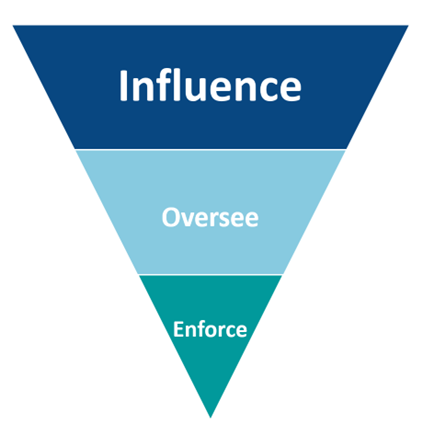
Our preference is to work with engaged and willing licence holders and other duty holders to support voluntary compliance.
What we do
The OIR will monitor the licence holder's compliance with an approved management plan and, where necessary, take enforcement action to provide assurance that a licence holder:
- maintains compliance with relevant requirements and obligations as described in the management plan and in accordance with relevant legislation
- ensures activities are being carried out in a safe and responsible manner
- drives continuous improvement.
To fulfill our legislated functions, the OIR has powers to undertake inspections, investigations and enforcement, and provide advice to foster continuous improvement in industry performance.
Inspections
Inspections are undertaken to monitor a licence holder's compliance with relevant legislation, including the commitments they made in their management plan.
The OIR will conduct regular inspections to ensure a licence holder is complying with their obligations under the OEI Act framework.
The OIR applies the following principles when planning and conducting inspections:
- focus on offshore infrastructure activities with higher risks or targeted to drive greater risk reduction outcomes
- fair, impartial, within power and informed by the facts before inspectors at the time.
Investigations
The OIR can undertake investigations where there is a potential breach of the OEI Act, its regulations or an approved management plan to determine what happened, how it happened and what course of corrective action is warranted.
An inspection is usually initiated based on the review of a notifiable incident, a workforce complaint, information provided by a third party or if there is evidence of non-compliance.
Investigations are undertaken to gather and establish the facts of the incident, determine whether action has been taken or needs to be taken to prevent recurrence, if there has been breaches of legislation for which OIR is the enforcing authority and establish whether to take further action, including formal enforcement.
Enforcement
When a licence holder breaches the OEI Act, its regulations, or an approved management plan then the OIR may take enforcement action to rectify the breach, hold the responsible parties to account, and/or provide deterrence to the industry.
The OIR has access to a range of enforcement tools including directions, prohibition and improvement notices, infringements, injunctions, enforceable undertakings and adverse publicity orders, and we will use them where a duty holder is disengaged or unwilling to comply.
Typically, enforcement action is taken based on information discovered during an inspection or following an investigation.
If an enforcement action is taken, it is the licence holder's responsibility to respond and rectify the issue to the OIR's satisfaction. If the response is not to a satisfactory standard, the OIR can seek to take further enforcement, including prosecution.
Enforcement action will be undertaken in a transparent, efficient and consistent manner according to the principles of procedural fairness.
Advice
The OIR has functions to provide advice to stakeholders on work health and safety, infrastructure integrity and environmental protection in connection with offshore infrastructure activities under the OEI Act framework.
The OIR also has functions to promote the work health and safety of persons engaged in offshore infrastructure activities.
Through our advice and promotion activities we aim to:
- enhance stakeholder understanding of regulatory requirements and obligations
- encourage and promote duty holders' compliance with regulatory requirements and obligations
- encourage and promote continuous improvement in work health and safety, infrastructure integrity and environmental management outcomes
- communicate emerging work health and safety, infrastructure integrity and environmental management issues and lessons learned from the conduct of our regulatory activities
- supplement and support broader compliance and enforcement activities and initiatives
- engage with stakeholders in a way that meets the needs of stakeholders and optimises the fulfilment of our legislated functions.